Two Pokémon cards with the same name, the same art and the same number can be worth very different amounts. What separates them is printed on the card: a set code, a number, a rarity symbol, a foil pattern, a stamp. This guide shows where each of those sits, how to read it, and what Card DB and Cardmarket call the result, so the card you list is the card you hold.
Where the card tells you what it is
Everything that identifies a card is in the bottom strip, under the attacks. Where exactly depends on the era.
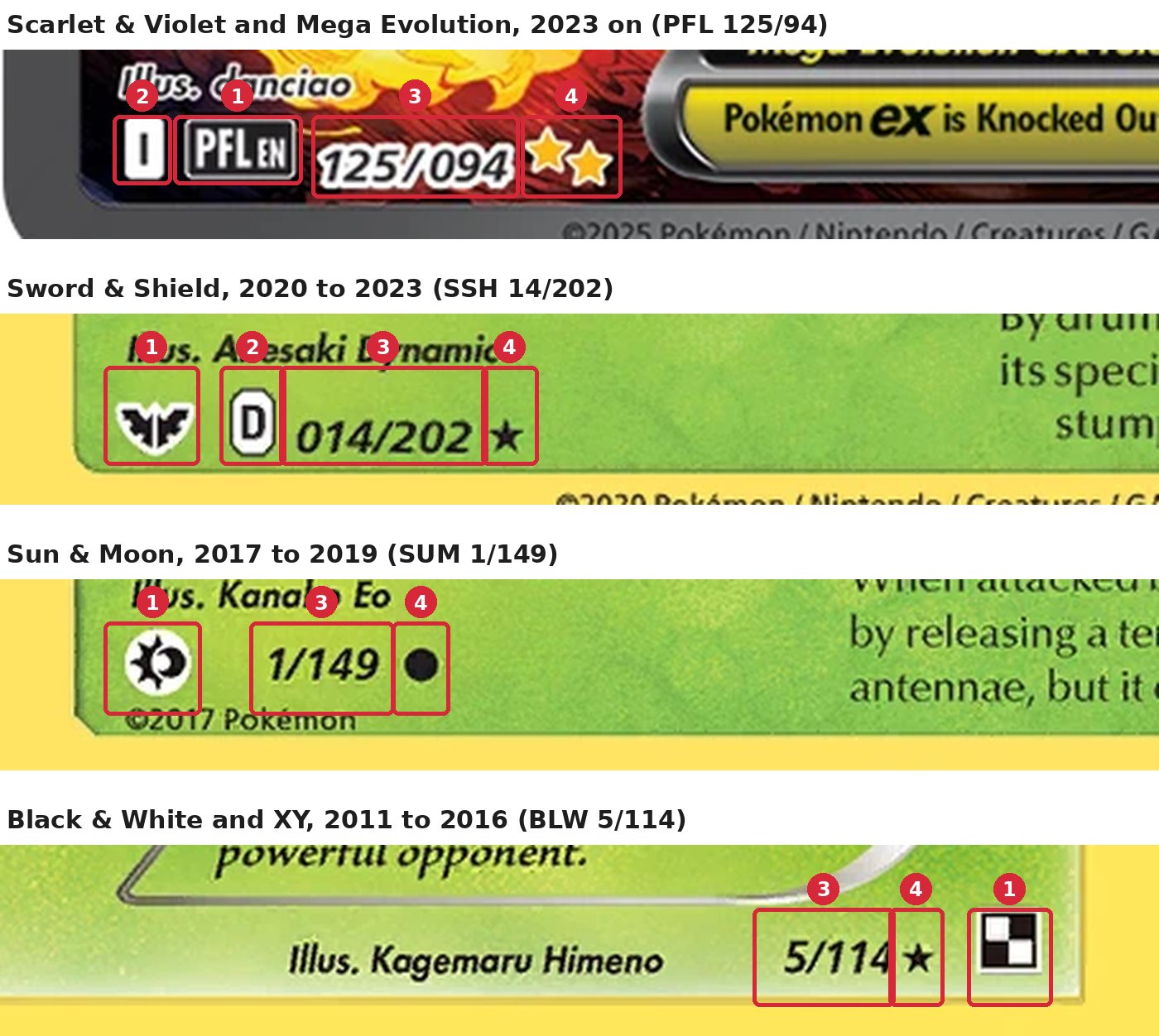 1 set code or set symbol, 2 regulation mark, 3 collector number, 4 rarity symbol.
- Scarlet & Violet and Mega Evolution, 2023 on. The set is printed as a
code with the card's language beside it,
PFL EN. A regulation letter,GtoJ, sits left of it. The number has three digits,125/094, and the rarity symbol follows it. - Sword & Shield, 2020 to 2023. The set's symbol, bottom left, then a
regulation letter,
DtoF. Three-digit number,014/202, then the rarity symbol. - Sun & Moon, 2017 to 2019. The set's symbol, bottom left, then the number
1/149and the rarity symbol. - Black & White and XY, 2011 to 2016. Everything is bottom right: the
number
5/114, the rarity symbol, then the set's symbol.
From Scarlet & Violet on, the set is spelled out for you: PFL is Phantasmal
Flames, SVI is Scarlet & Violet. Before that the card shows only the set's
symbol. The quickest way to name an older set is to search the card's name in
Card DB and pick the result whose number matches the one on your card.
The regulation letter says which tournament formats a card may be played in. It does not identify a printing; read past it.
A yellow circled A beside the symbol on a Sun & Moon card is not a regulation
mark. It marks an existing card reprinted with new art, and every Hidden Fates
Shiny Vault card carries it. The set symbol beside it is not Hidden Fates'
usual one, so identify those cards by their SV number, described below, not
by the symbol.
How Card DB writes the number
Card DB drops the leading zeros and writes the number over the set's printed
size: the card that prints 125/094 is PFL 125/94.
Numbers past the set size
125/094 is not a misprint. In Scarlet & Violet and Mega Evolution, every
Illustration Rare, Ultra Rare, Special Illustration Rare and Hyper Rare is
numbered past the set size, and no Common, Uncommon, Rare or Double Rare is.
Phantasmal Flames prints /094 and runs to 130.
Some sets have a subset with its own prefix and its own count. The prefix is
part of the number and is printed on the card: Hidden Fates' Shiny Vault
Scyther prints SV1/SV94.
| Prefix | Sets in Card DB | In Card DB |
|---|---|---|
TG Trainer Gallery |
Brilliant Stars, Astral Radiance, Lost Origin, Silver Tempest | BRS TG05 |
GG Galarian Gallery |
Crown Zenith | CRZ GG01 |
SV Shiny Vault |
Hidden Fates, Shining Fates | HIF SV1, SHF SV001 |
RC Radiant Collection |
Generations, Legendary Treasures | GEN RC1 |
TG05 is not card 5. In Brilliant Stars, BRS 5 and BRS TG05 are two
different cards. Card DB writes a prefixed number without a slash, the way you
would type it: BRS TG05 Zekrom, SHF SV001 Rowlet.
The SV prefix of Shiny Vault has nothing to do with the Scarlet & Violet
era. It belongs to Hidden Fates (2019) and Shining Fates (2021).
Black Star Promos
A promo card prints a promo code instead of a set code, a number with no set
size after it, and a star with the word PROMO in place of the rarity symbol:
SVP EN 001, MEP EN 001. Card DB lists these as their own sets, SVP and
MEP.
A promo is its own card, even when it shows the same Pokémon and art as a set card and carries a stamp. If the number on the card is a promo number, look it up under SVP or MEP, not under the set.
Rarity symbols
Rarity is printed after the number. The common symbols from Scarlet & Violet on:
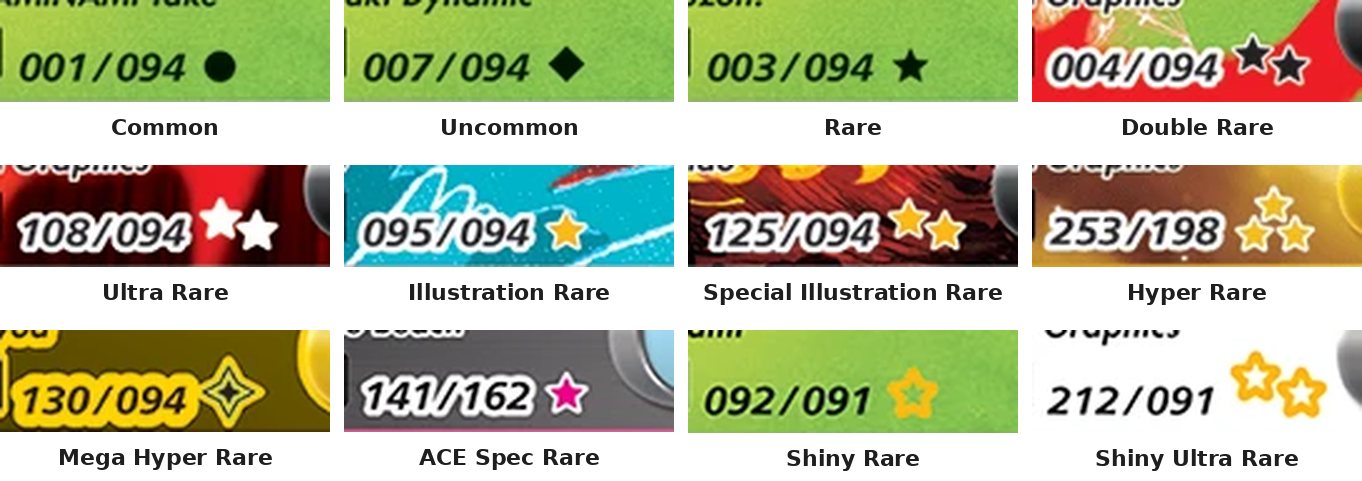 Every symbol is cropped from a real card: PFL, SVI, TEF and PAF.
| Symbol | Rarity |
|---|---|
| Black circle | Common |
| Black diamond | Uncommon |
| One black star | Rare |
| Two black stars | Double Rare |
| Two white stars | Ultra Rare |
| One gold star | Illustration Rare |
| Two gold stars | Special Illustration Rare |
| Three gold stars | Hyper Rare |
| Gold four-pointed star in an outline | Mega Hyper Rare |
| Pink star | ACE Spec Rare |
| One gold outlined star | Shiny Rare |
| Two gold outlined stars | Shiny Ultra Rare |
A few sets add rarities of their own, such as Black White Rare in Black Bolt and White Flare. For those, look the card up in Card DB by its number.
Before Scarlet & Violet the symbol is only a circle, a diamond or a star. A
black star covers both a Rare and a Holo Rare: EVS 1/203 Pinsir, a Rare,
and EVS 4/203 Jumpluff, a Holo Rare, carry the same one. The star does not
tell you whether the art is foil; looking at the art does.
Rarity is not the printing. A Common has the same circle whether it is the plain card, its Reverse Holo, or a Poké Ball pattern. The symbol never tells you which printing you hold. The surface does.
Which printing: read the foil
One collector number can be several cards. Phantasmal Flames' commons come plain or in Reverse Holo, and Prismatic Evolutions' Pokémon commons come in four printings. Card DB lists each as its own row under the number.
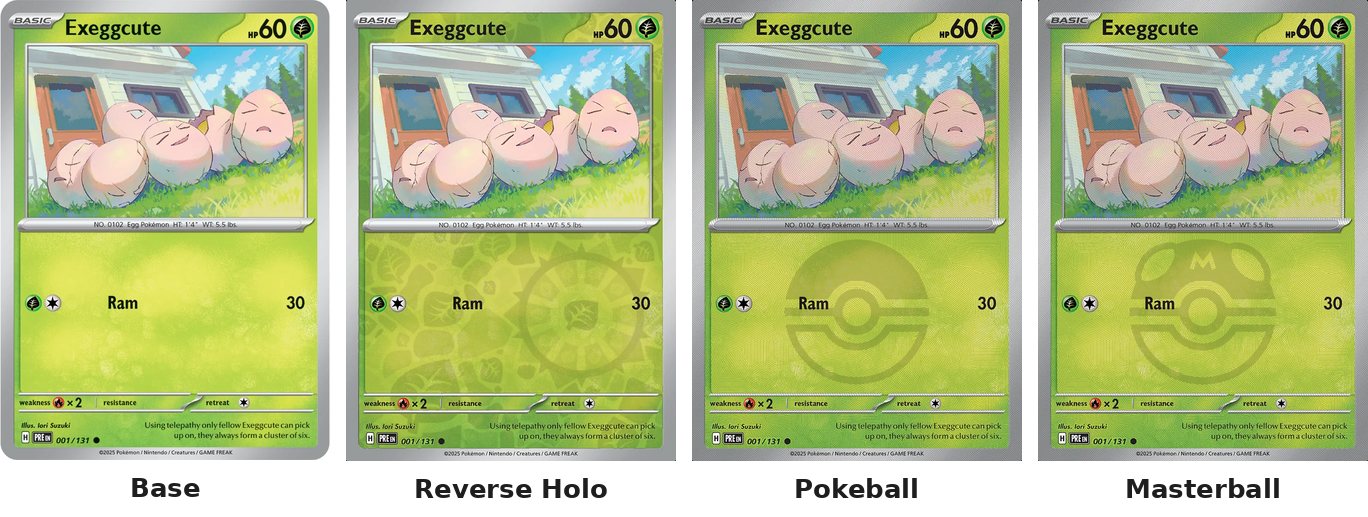
PRE 1/131 Exeggcute in the four printings Card DB holds for it. Card DB
renderings of each printing, not photographs.
Holo and Reverse Holo
- Holo: the artwork is foil, the rest of the card is not.
- Reverse Holo: everything except the artwork is foil. Recent sets such as Prismatic Evolutions and Black Bolt foil it in a pattern: one large type symbol among small ones, as on the second card above.
That is the whole test: tilt the card under a light and see which part shines.
A Holo Rare from a pack is the set's own card, the base row in Card DB, not a
variant. Card DB uses the variant name Holo only for a card that is not
holo in its pack printing and also exists in holo.
Cardmarket's own guide calls listing a Holo as a Reverse Holo, or the other way round, "the most common mistake" sellers make. A Holo Rare and the same card in Reverse Holo share a number and a product page on Cardmarket and sell for different prices.
In Card DB, Reverse Holo printings exist for Commons, Uncommons and Rares, and for Holo Rares before Scarlet & Violet. Double Rare, Ultra Rare, Illustration Rare, Special Illustration Rare, Hyper Rare and ACE Spec Rare cards have none.
Poké Ball and Master Ball patterns
Prismatic Evolutions, Black Bolt and White Flare print some cards with a ball
pattern across the card, as well as a plain Reverse Holo. Card DB names these
Pokeball and Masterball.
- Pokémon cards come in both patterns.
- Trainer and Energy cards come only in the Poké Ball pattern. A Trainer with
a ball pattern is always
Pokeball.
On a Pokémon card, the tell is the shape of the ball:
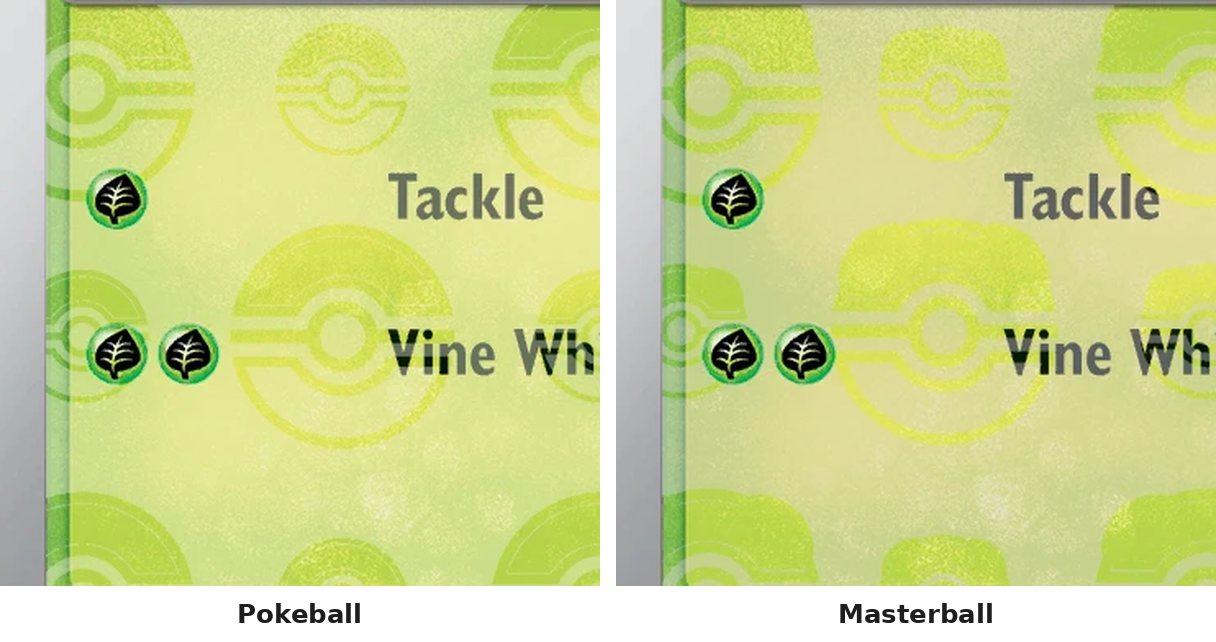
BLK 1/86 Snivy Pokeball and Masterball, Card DB renderings. The Master Ball
has two rounded bumps on its upper half.
- Poké Ball: a plain circle, a band across the middle, a button in the centre.
- Master Ball: the same, plus two rounded bumps on the upper half of the
ball. On the large single ball of Prismatic Evolutions you can also see the
M.
Ascended Heroes: Reverse Energy and Reverse Pokeball
Ascended Heroes prints its Pokémon cards in two reverse patterns: a single
large energy symbol of the card's type with nothing else around it, or a
single large ball. Card DB names them Reverse Energy and Reverse Pokeball.
The ball is not always a Poké Ball: its design changes from card to card, so a
different-looking ball on an Ascended Heroes card is still Reverse Pokeball,
not a Master Ball.
Its Trainer and Energy cards come in a plain Reverse Holo instead.
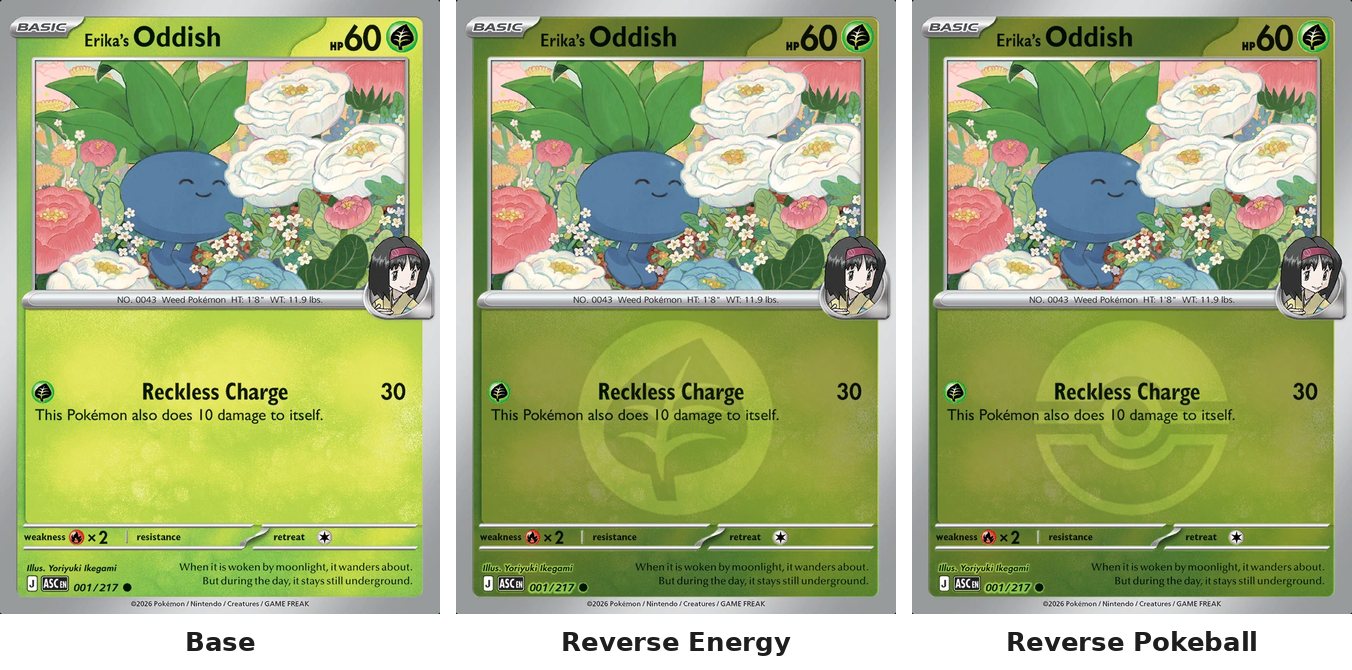
ASC 1/217 Erika's Oddish: base, Reverse Energy, Reverse Pokeball. Card DB
renderings, not photographs.
Printings a flat picture cannot show
These exist in Card DB, but a straight-on picture does not show them. The tell is on the card:
| Card DB name | What to look for |
|---|---|
Cosmos Holo |
The artwork foiled in a pattern of dots, circles and planets |
Reverse Cosmos Holo |
The same pattern on everything except the artwork |
Tinsel Holo |
Horizontal stripes across the artwork. Black Bolt and White Flare only |
Non-Holo |
No foil at all, on a card that is foil in its pack printing |
Jumbo |
An oversized card |
A card that is plain in its pack is just the base card: it has no Non-Holo
row. Non-Holo exists only where the pack version is foil.
Stamps
A stamp printed on a set card makes it a separate printing. Card DB names the printing after what the stamp shows, never after where the card came from. The most common:
| The stamp shows | Card DB name |
|---|---|
| The set's own logo | Stamped |
| A retailer logo | GameStop, EB Games, BestBuy |
| The word STAFF | Staff |
| A Pokémon Center mark | Pokemon Center |
| A snowflake (Holiday Calendar cards) | Snowflake |
| A tournament winner mark | Winner Stamp |
A stamped card and the unstamped card from the pack do not share a price. Listing one as the other loses money one way or the other.
Reprints that carry another set's number
30th Celebration (30C) reprints 30 well-known cards from earlier sets as its
Classic Collection. Each prints the original card's number, and its set mark
where the original had one: the 30th Celebration Magikarp still reads
PAL EN 203/193, exactly like the Paldea Evolved original.
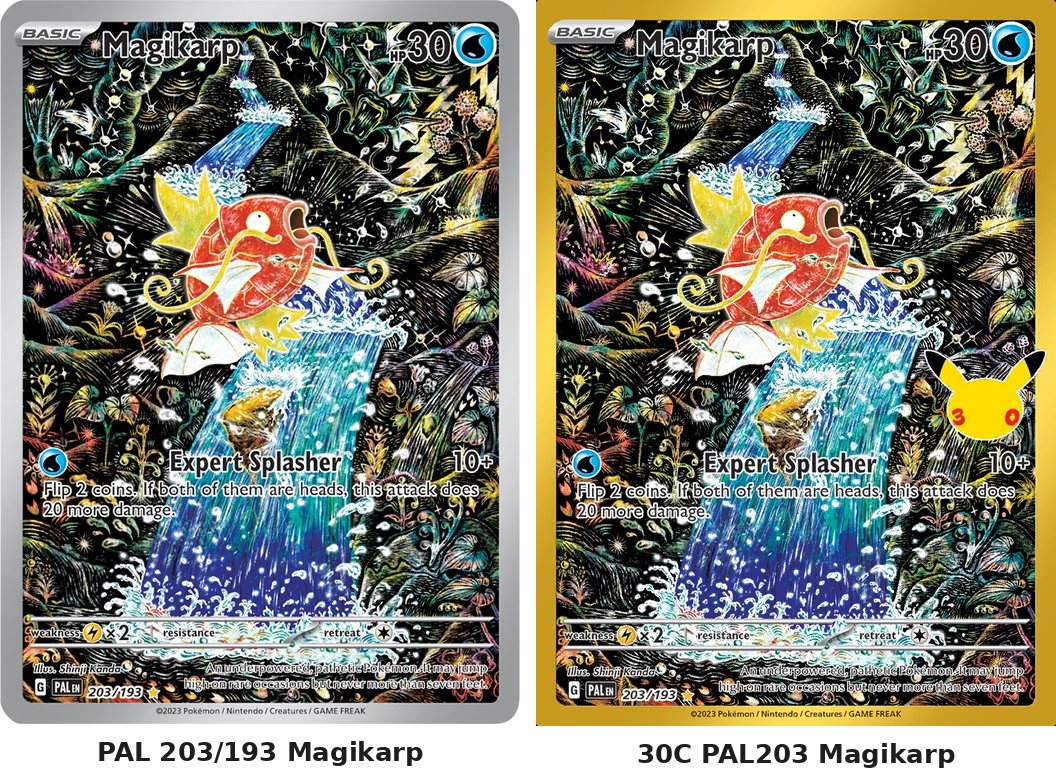 The original (left) and the 30th Celebration reprint (right): gold border,
30 logo with Pikachu on the art.
Two marks tell them apart: the reprint has a gold border and a 30
logo with a Pikachu on the artwork. Card DB files the reprint under 30th
Celebration with the original set's code as part of the number:
30C PAL203 Magikarp, rarity Classic Collection, never as
PAL 203/193. The Base Set Charizard reprint, printed 4/102, is
30C BS4 Charizard.
Celebrations (2021) has a Classic Collection reprint run as well. Card DB does not list those reprints.
How Card DB names a card
A card's full name in Card DB is:
SET NUMBER Name Variant
PFL 125/94 Mega Charizard X ex: the base card, no variant.PRE 1/131 Exeggcute Masterball: a printing of that number.30C PAL203 Magikarp: a prefixed number, written without a slash.
The variant names the printing and nothing else. Rarity is never part of the name, and neither is the box, tin or event a card came from.
How Cardmarket handles it
- Reverse Holo is a box you tick, not a separate product. A card and its plain Reverse Holo share one Cardmarket product. Card DB reads the Reverse Holo's price from that product's reverse holo prices.
- Pattern, Cosmos, stamped and Non-Holo printings have their own product. That covers Poké Ball and Master Ball patterns, Ascended Heroes' Reverse Energy and Reverse Pokeball, Cosmos Holo, stamps and Non-Holo cards. They are often in a second "Additionals" expansion beside the set's main one.
- List a ball pattern on its own product with Reverse Holo ticked. Card DB reads Poké Ball and Master Ball prices from those products' reverse holo prices, because that is where they trade.
- Cardmarket's badge is not always the card's name. Cardmarket overlays a blue badge on some product images:
| Cardmarket badge | Card DB name |
|---|---|
| Cosmos Holo, Cosmo Foil Version | Cosmos Holo |
| Non-Holo Version | Non-Holo |
Language and region
- On the card: from Scarlet & Violet on, the box beside the set code
carries the card's language (
ENon English cards). Before that, read the card text. - On Cardmarket: English, French, German, Spanish, Italian and Portuguese cards share one product, and you pick the language on your listing. Japanese, Korean and Chinese cards have their own expansions and numbering, and Cardmarket does not allow them on the western product pages.
- The number does not carry across. A Japanese card's set code and number belong to the Japanese release. Do not match it to an English card by its number.
Mistakes that cost money
- A Holo listed as a Reverse Holo, or the other way round.
- A Master Ball sold as a Poké Ball. Check for the two bumps.
- A Classic Collection reprint listed as the original, or the original as the
reprint. Check the border and the
30logo. - A Black Star Promo listed as the set card it resembles. Check for the promo number.
- A stamped card listed as the plain pack card.
- A number past the set size typed as a different card:
125/094isPFL 125/94, not a misprint. - A Trainer Gallery or Shiny Vault card entered by its bare number:
TG05is not card 5. - A Japanese card listed on a western product page.
Sources
- Card images: Card DB. The bottom strips, rarity symbols and Classic Collection pair are crops of card images; the Prismatic Evolutions, Black Bolt and Ascended Heroes figures are Card DB renderings of each printing.
- Card names, printings and rarities: the Card DB catalogue.
- Finding and listing Pokémon cards, Cardmarket's help centre: languages, Reverse Holo.
- Scarlet & Violet (TCG), Bulbapedia: set codes and language codes replacing the set symbol.
- Holiday Calendar promos, PokeGuardian: the snowflake stamp.
Pokémon card images and names belong to The Pokémon Company, Nintendo, Creatures and GAME FREAK. This page is a collector reference and is not affiliated with them.