One One Piece card number can be many different cards. Card DB holds nine
printings of OP01-016 Nami, sold in boosters, decks, a premium booster and
collection sets, and every one of them prints the same OP01-016 in
the corner. This guide shows what the card does print, how to
work out which printing you hold, and what Card DB and Cardmarket call it.
Where the card tells you what it is
Everything that identifies a card sits in its bottom right corner.
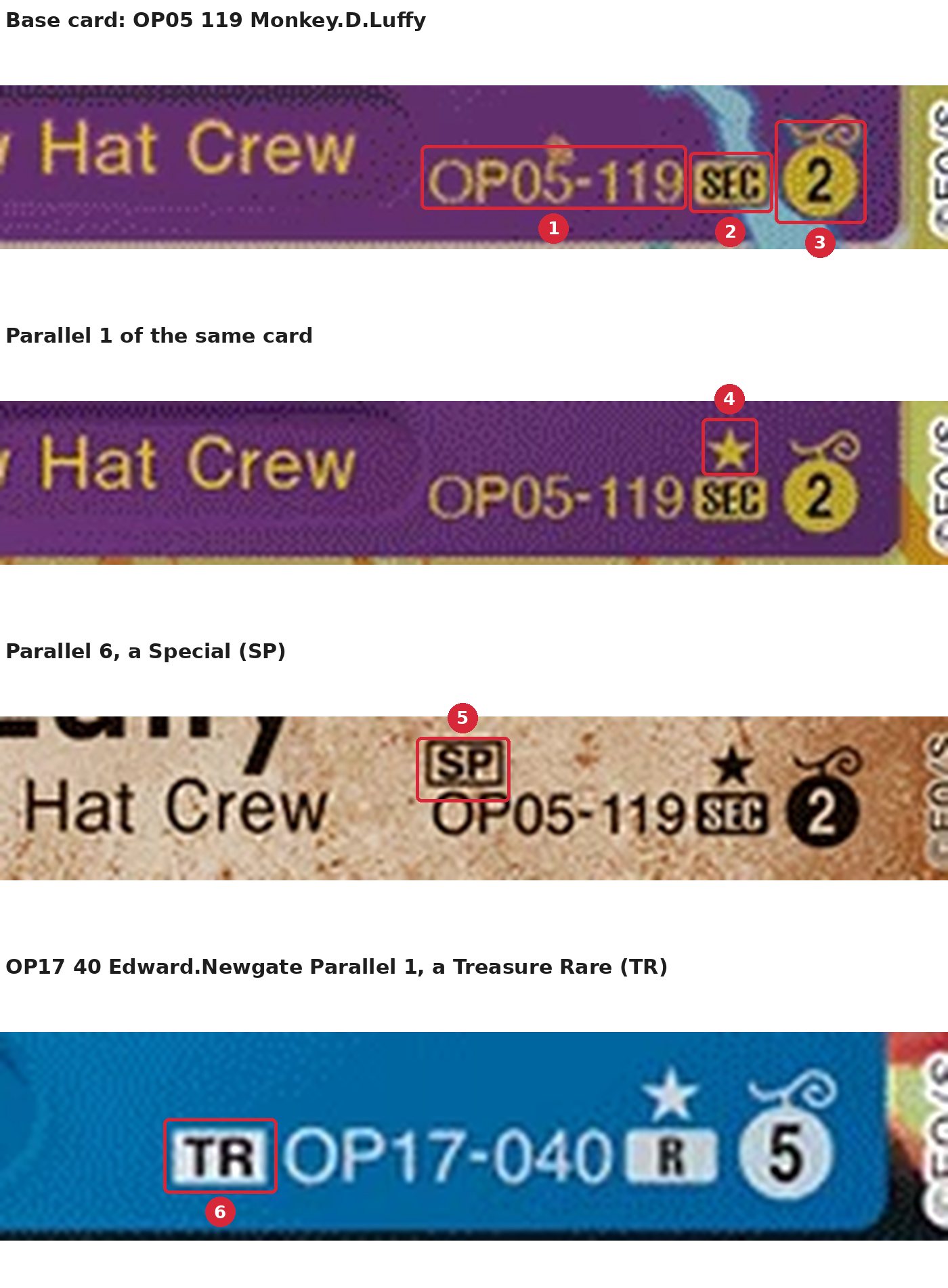 1 card number, 2 rarity, 3 block symbol, 4 parallel star, 5 SP box, 6 TR box.
Crops of Card DB images.
- Card number,
OP05-119: the set's code, a hyphen and three digits. There is no set size after it. - Rarity, in a small box after the number:
C,UC,R,SR,SEC,L,Por, on a few Treasure Rares,TR. - Block symbol, the round mark after the rarity. Bandai's rules say it
marks the block the card belongs to and does not affect play. It does not
identify a printing, and a reprint can carry a different one:
OP01-016prints block1in its first printing andXin Starter Deck ST-31. - Star above the rarity box: means the card is a parallel. Many parallels have none; see below.
SPorTRbox beside or above the number: usually printed on Special and Treasure Rare printings.
Bandai's card images, which Card DB uses, carry a large SAMPLE across the middle. That is part of Bandai's published image, not of the card.
How Card DB writes the number
Card DB drops the hyphen and the leading zeros: the card that prints
OP01-016 is OP01 16 Nami, and the promo P-001 is
P 1 Monkey.D.Luffy.
The set is the code, not the box
The letters before the hyphen are the set, and Card DB files every card under them:
| Code on the card | What it is | In Card DB |
|---|---|---|
OP01 to OP17 |
Booster packs | OP01 16 Nami |
ST01 to ST36 |
Starter decks, Ultra decks | ST01 7 Nami |
EB01 to EB04 |
Extra boosters | EB04 7 Roronoa Zoro |
PRB01, PRB02 |
Premium boosters | PRB02 1 Koby |
P |
Promotion cards | P 1 Monkey.D.Luffy |
The product a card came out of is often not the set its code names. Of the 1,646 parallels on Bandai's English card list, 866 were sold outside their code's set: 491 in another set's boosters or decks, the rest in collection sets and event or promotion packs. Three examples:
- The SP Roronoa Zoro numbered
EB04-007was in OP-17 boosters. It isEB04 7 Roronoa Zoro Parallel 2, not an OP-17 card. - EB-04 has no box of its own. Its cards first came inside OP-14 and OP-15 boosters.
- Premium Booster PRB-01 holds one card numbered
PRB01. The rest of it is reprints and new parallels of older cards, carrying their original numbers and filed under those.
So read the code on the card and ignore the wrapper. A card from an OP-17
pack that prints EB04-007 is looked up under EB04.
Rarity
Bandai's product pages list the rarities by name. Card DB uses the same names:
| Printed | Card DB rarity |
|---|---|
C |
Common |
UC |
Uncommon |
R |
Rare |
SR |
Super Rare |
SEC |
Secret Rare |
L |
Leader |
P |
Promo |
SP box |
Special |
TR box |
Treasure Rare |
SP and TR are read from the extra box, not the rarity box. A Special or
Treasure Rare printing usually keeps the original card's rarity in its rarity
box: the Treasure Rare Edward.Newgate prints TR OP17-040 R. Card DB lists it
as OP17 40 Edward.Newgate Parallel 1, rarity Treasure Rare, and the plain
card as rarity Rare. List the first by its rarity box and you have called a
Treasure Rare a Rare.
The box is not universal. The Treasure Rare OP13 37 Roronoa Zoro Parallel 1
prints TR inside the rarity box and has no separate box, and the Special
OP09 20 Come On!! We'll Fight You!! Parallel 2 prints no SP mark at all.
Where the corner does not say, the Card DB rows for the number do: find the
row whose illustration matches your card.
Every Special and every Treasure Rare in Card DB is a parallel of a card that
also exists as a base card, never a base card itself. From OP-06 on, each
booster set has one Treasure Rare, and most of them carry an earlier set's
number: the OP-06 Treasure Rare is ST01-007 Nami.
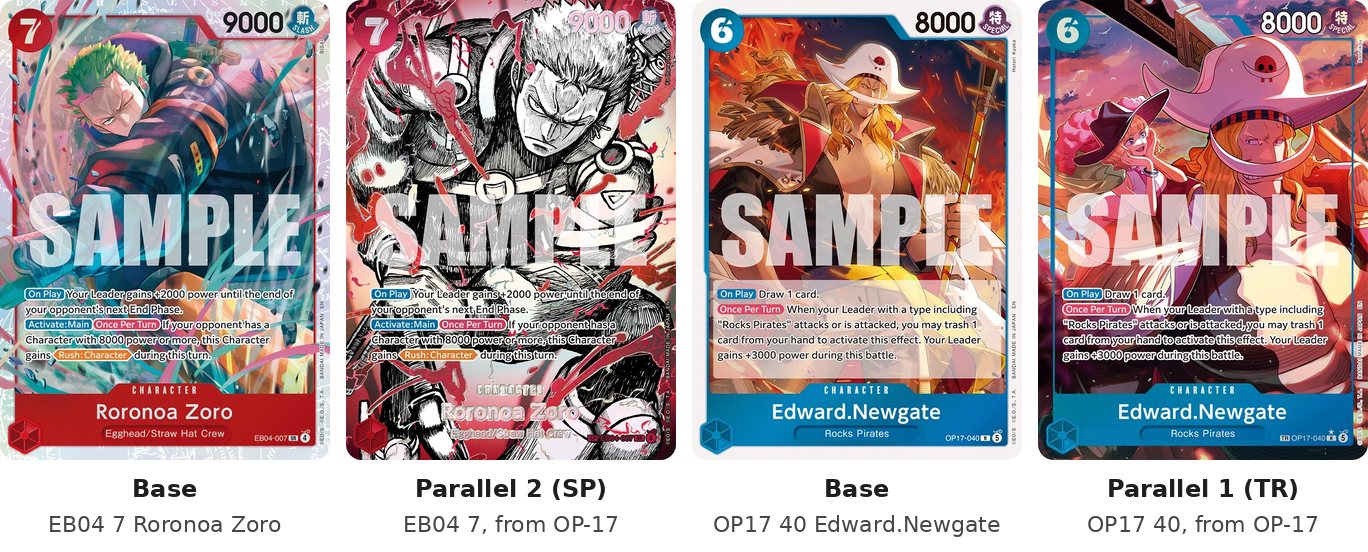 Two cards and their Special and Treasure Rare parallels. Card DB images.
Parallels: one number, several cards
A parallel is the same card, with the same number and the same text, printed with a different illustration or frame. Card DB lists the plain card as the base row and each parallel as its own row:
OP01 120 ShanksOP01 120 Shanks Parallel 1OP01 120 Shanks Parallel 2OP01 120 Shanks Parallel 5
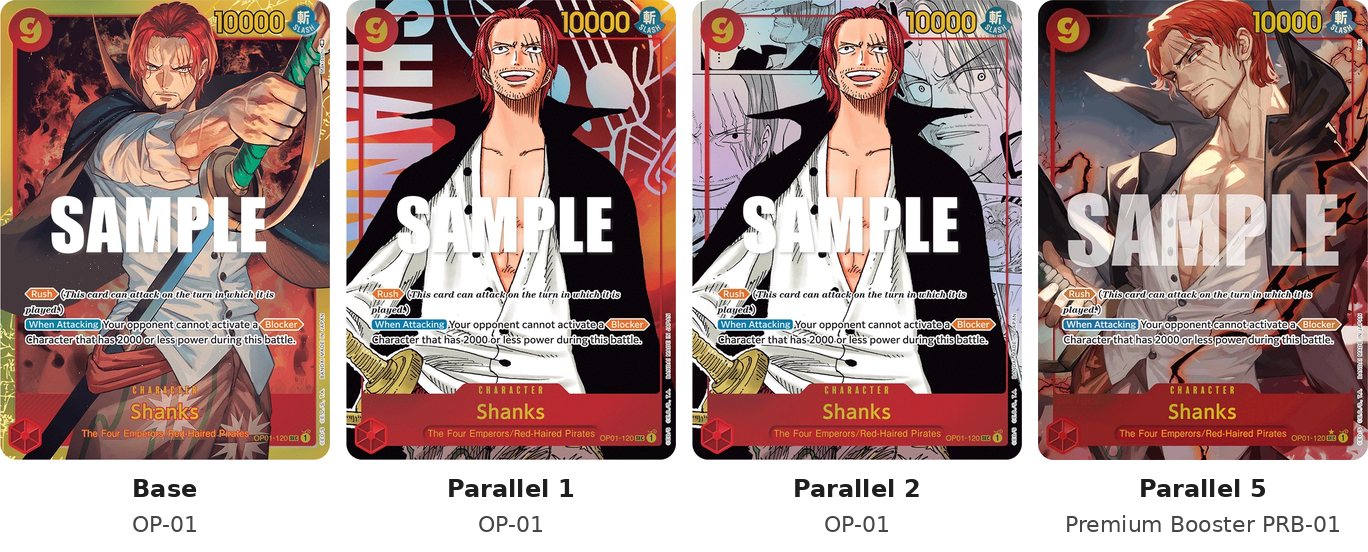
OP01 120 Shanks in the four printings Card DB holds, with the product each
came in. Card DB images.
The parallel number is not on the card. Bandai's English card list gives
every printing an id, and a parallel's id ends in _p1, _p2 and so on. Card
DB takes Parallel 1, Parallel 2 from that id and nothing else. Three things
follow:
- The numbers skip. Shanks above has Parallel 1, 2 and 5, because the
English card list has no
_p3or_p4for that card. 120 of the 997 numbers that have parallels in Card DB skip at least one. - A higher number is not a rarer card. It is only a later entry in
Bandai's list. Card DB holds parallels up to
Parallel 9. - The numbers belong to the English list. Bandai's Japanese card list
numbers its own parallels: the Zoro alternate art that is
OP01-001_p1on the English site isOP01-001_p2on the Japanese one.
Manga art, anime art and alternate art are all named Parallel plus a number.
The star
A star above the rarity box means the card is a parallel. From OP-04 on, the alternate-art parallels in booster and premium booster packs print it.
Its absence proves nothing. Most Specials and Treasure Rares, every event and tournament printing, and the OP-01 to OP-03 parallels have no star, so a card without one can still be a parallel. The star also never tells you which parallel a card is.
Which parallel you hold
Nothing printed on the card names the parallel. The test is the illustration, the frame colour and any stamp printed across the art. Look the number up in Card DB and compare your card with each row under it. Four traps:
- Same drawing, different background and colour. Shanks Parallel 1 and Parallel 2 above share one drawing of Shanks. Parallel 1 has a red background, Parallel 2 a grey manga-panel one.
- Same drawing, different colour. Some Specials come in two colourways
of one drawing:
OP05 119 Monkey.D.LuffyParallel 7 is pastel rainbow and Parallel 8 gold;OP09 4 ShanksParallel 5 is red and Parallel 6 pale silver. - Same art, different stamp. Tournament prize cards share one
illustration and differ only by the stamp across it.
OP07 21 UrougeParallel 1 and 5 carry a REGIONALS stamp, OFFLINE on Parallel 1 and ONLINE on Parallel 5; Parallel 3 and 6 add FINALIST, and Parallel 4 and 7 add Champion, again OFFLINE first and ONLINE second. - Same art, different printing. Nami's Parallel 3, from Ultra Deck ST-10,
and Parallel 9, from Starter Deck ST-31, share their illustration. Parallel
9 has a solid red frame, block symbol
XandENon its right edge; Parallel 3 has a pale frame with a faint map pattern, block symbol1and noEN.
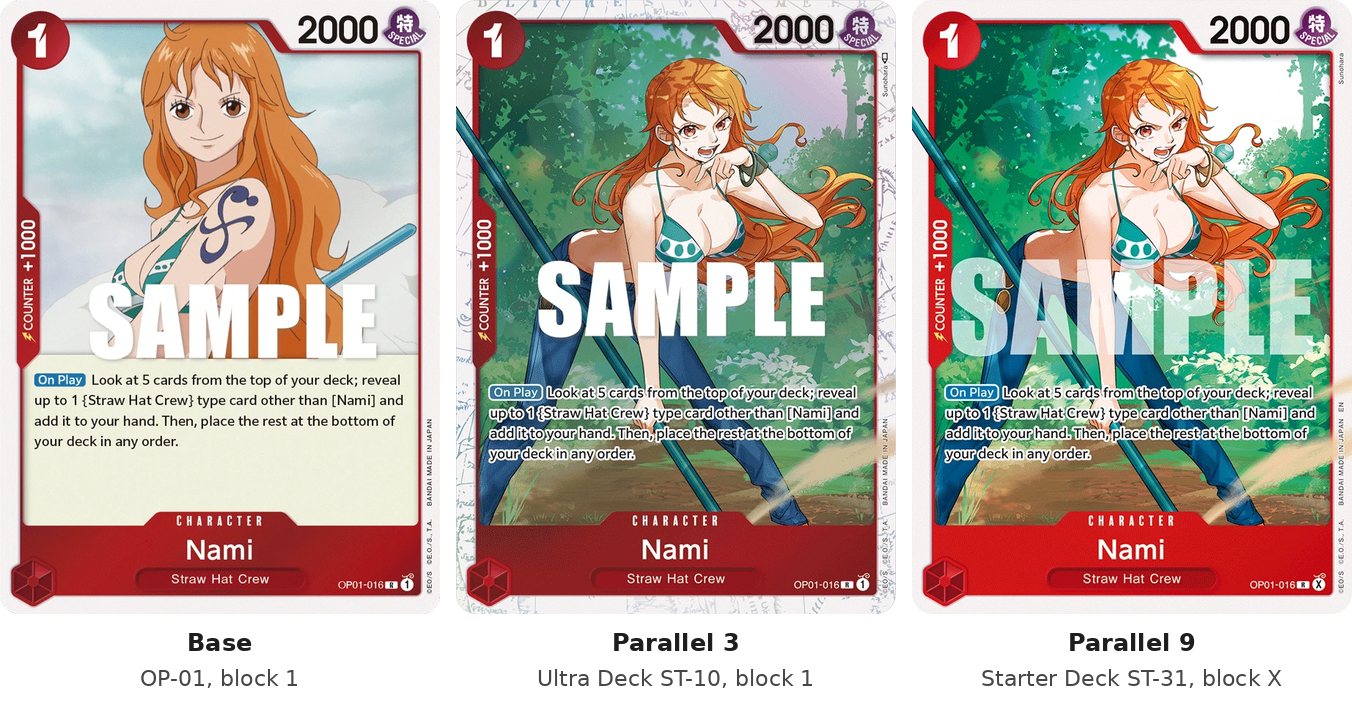
OP01 16 Nami: the base card and two parallels that share one illustration.
Card DB images.
Promotion cards
A promo's number starts with P-, P-001, and its rarity box reads P.
Card DB lists them all under one set, P, One Piece Promotion Cards.
Promos have parallels too. P-001 Monkey.D.Luffy has six in Card DB, given at
the Super Pre-Release, in Premium Card Collection and Gift Collection sets and
in a 2024 regional participation pack. They are P 1 Monkey.D.Luffy Parallel 1
to Parallel 6, told apart by their art like any other parallel.
Cards given at events and in promotion or tournament packs print NOT FOR
SALE on the right edge, beside BANDAI MADE IN JAPAN, whatever their
number: the OP07-021 tournament prizes carry it too. Promos sold in
collection sets do not: P-001 Parallel 3, 4 and 6 have no NOT FOR SALE.
Reprints keep the original number
When Bandai puts an existing card into a later product, the card keeps its original number:
- With new art, it is another parallel of the original card. Nami's
printing in Starter Deck ST-31 is
OP01 16 Nami Parallel 9, not an ST-31 card. - With the original art unchanged, it is the same Card DB row as the original.
Language and region
- On the card: English cards printed from EB-02 and OP-11 (2025) on
print
ENafterBANDAI MADE IN JAPANon the right edge, whatever set code they carry. Older English cards have no language mark; read the card text. - Five languages: Bandai prints the game in Japanese, English, French, Simplified Chinese and Korean.
- Parallel numbers are English-list numbers. Card DB's parallel numbers follow Bandai's English card list. A Japanese card shares the card number but numbers its parallels differently, so do not take a Japanese card's parallel number as Card DB's.
 Right edges of
OP10 12, OP11 6 and P 70, turned to read across. Card
DB images.
How Card DB names a card
A card's full name in Card DB is:
SET NUMBER Name Variant
OP01 16 Nami: the base card, no variant.OP01 16 Nami Parallel 4: a parallel of that number. This one is a Special.P 1 Monkey.D.Luffy Parallel 2: a promo parallel.
The variant is only ever Parallel and a number. Rarity is never part of the
name, and neither is the product a card came out of.
How Cardmarket handles it
- Every printing is its own product. Cardmarket's One Piece price guide carries no foil prices at all (none of its 13,384 rows on 2026-10-06), so a parallel is never priced as a column of the base card's product. It is a separate product with its own price.
- The product name is almost always the card name and its number,
Edward.Newgate (OP17-040), and every printing of that number has the same name. Tell them apart by the picture. - Cardmarket files printings under the product they came in, not only
under the code's set.
Shanks (OP01-120)is 16 products in 7 Cardmarket expansions, among them three in OP-01 and three in Premium Booster PRB-01 (product list of 2026-10-06). Look in the expansion of the box your card came from, as well as the one its code names. - English cards have their own expansion. Cardmarket lists most One
Piece products twice: once under the product's name, and once more for
the non-English edition, whose page address ends in
Non-EnglishorAsia-Region-Legal. The two editions do not always hold the same cards: the English OP-13 booster's Treasure Rare isOP11-058Monkey.D.Luffy, which its non-English twin does not carry. List an English card under the English expansion. - One card number is usually several Cardmarket products. Cardmarket adds a product for each product the card appeared in: 2,761 of the 2,835 One Piece card numbers sit in two or more expansions.
Mistakes that cost money
- A parallel listed as the base card, or as the wrong parallel. Compare the art with every Card DB row for that number.
- A Special or Treasure Rare listed by its rarity box:
TR OP17-040 Ris a Treasure Rare, not a Rare. - A card filed under the box it came from instead of its code: an
EB04-007pulled from an OP-17 pack is an EB04 card. - A parallel number taken from a Japanese card list or a Japanese card.
- A missing star read as proof of a base card. Specials, Treasure Rares, event printings and OP-01 to OP-03 parallels often have none.
- Two printings that share an illustration treated as one: check the frame, the block symbol and any stamp across the art.
- Two printings that differ only by an event stamp treated as one: OFFLINE and ONLINE, FINALIST and Champion are different cards.
Sources
- Card images: Card DB. Every figure is a crop or a row of Card DB images, which are Bandai's card-list pictures.
- Card names, numbers, printings and rarities: the Card DB catalogue.
- Card list, Bandai's English One Piece Card Game site: card ids, rarities and the product each printing was sold in.
- Comprehensive rules and rule manual, Bandai: card number, rarity and block symbol.
- Rules for the use of different languages, Bandai: the five language versions.
- THE TIME OF BATTLE [OP-16], Bandai's product page: the rarity names.
ONE PIECE card images and names belong to Eiichiro Oda, Shueisha, Toei Animation and Bandai. This page is a collector reference and is not affiliated with them.