NARUTO Mythos has the most intricate printing model of any game in this catalogue. One collector number can hold six different cards, rarity works differently than in other games, and the second set added four rarities that exist nowhere else. This guide explains the system using the publisher's own collection guides, so you can tell exactly what you are looking at, on a card page here or on a card in your hand.
One number, many cards
In most games, a collector number names one card and everything sharing that number is a treatment of it. Not here. In NARUTO Mythos, rarity is part of a card's identity: a number's Rare and its Rare Art are different cards, often with different artwork and different subtitles.
KS 133 is the extreme case. Six cards carry that number: a Legendary, two
Mythos promos, two Secrets and a Secret Variant. Four of them are different
cards with their own art, not versions of one another.
So a NARUTO Mythos card is identified by four things together:
| Part | Example | What it tells you |
|---|---|---|
| Set code | KS |
Konoha Shidō (set 1) or SS, Shinobi Shiren (set 2) |
| Collector number | 133/130 |
The card's number, which can exceed the set size |
| Name | Naruto Uzumaki |
Which character or attachment it is |
| Printing | Secret Variant |
Which of the number's cards this one is |
On this site, every printing is listed separately under its number, with the printing named after the card. When a number holds several cards, each has its own page.
Rarity, finishing and artwork are three different things
The clearest thing the publisher's checklist says is structural: it lists rarity and finishing as two separate columns.
- Rarity says which print run a card belongs to: Common, Uncommon, Rare, Rare Art, Secret, Legendary, Mythos, Mission, and set 2's Chibi, Special, POP and Shinobi.
- Finishing says what the surface does: Holo, Holo Special, Holo Embossed, Gold, Gold 22K, Serialized.
Full Art appears in neither list. It is an artwork treatment, a third axis: the same card with its illustration extended across the whole face. Keeping these three apart is the key to the whole system. A card can be a Common (rarity) in its Full Art layout (artwork) with a holographic surface (finishing), and each of those three words answers a different question.
Normal, Full Art and Holographic
The publisher's Konoha Shidō collection guide describes the three versions of a Common or Uncommon like this:
Each card of these types is available in three versions: standard, fullart, and holographic. The FullArt version highlights the complete artwork for a more immersive and collectible visual experience, while the holographic version adds dynamic diagonal rainbow effects, offering players a refined and striking aesthetic option.
In hand, the three are easy to tell apart:
| Version | How it looks |
|---|---|
| Normal | Black title bar, the art sits in a window, solid white panel across the bottom |
| Full Art | The same art extended to all four edges, sky blue title bar, no white panel |
| Holographic | The Full Art layout plus a diagonal rainbow sheen across the face |
The quick test: white bottom panel means Normal, art to the edges means Full Art, art to the edges plus a rainbow sheen means Holographic. Holographic is a finish applied to the Full Art face, not a third layout.
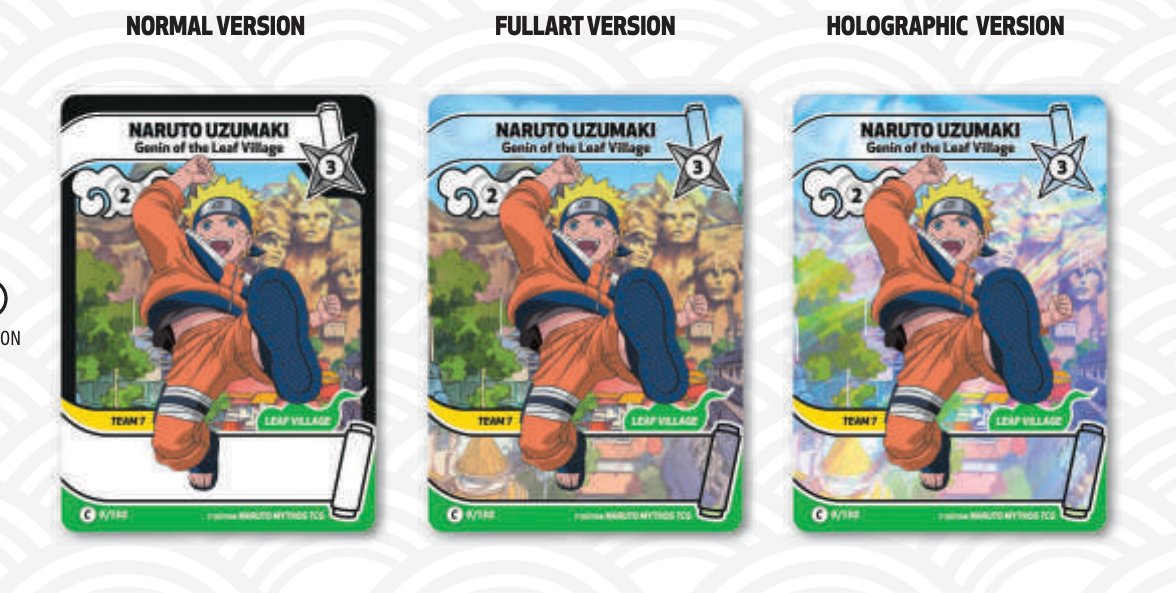 The three versions of card 009, from CICABOOM's Konoha Shidō collection guide.
Which versions exist depends on the set and the card type
The three versions above are not printed uniformly. Per the publisher's collection guides:
| Cards | Versions printed |
|---|---|
| Konoha Shidō, numbers 1/130 to 103/130 (both editions) | Normal, Full Art and Holographic |
| Shinobi Shiren Characters, 1/140 to 78/140 | Full Art and Holographic only, no Normal |
| Shinobi Shiren Attachments, 79/140 to 110/140 | Standard and Holographic only, no Full Art |
So Konoha Shidō prints three versions per number, and Shinobi Shiren prints two, with the pair depending on whether the card is a Character or an Attachment. A Shinobi Shiren Character with a white bottom panel or a Shinobi Shiren Attachment in Full Art does not exist.
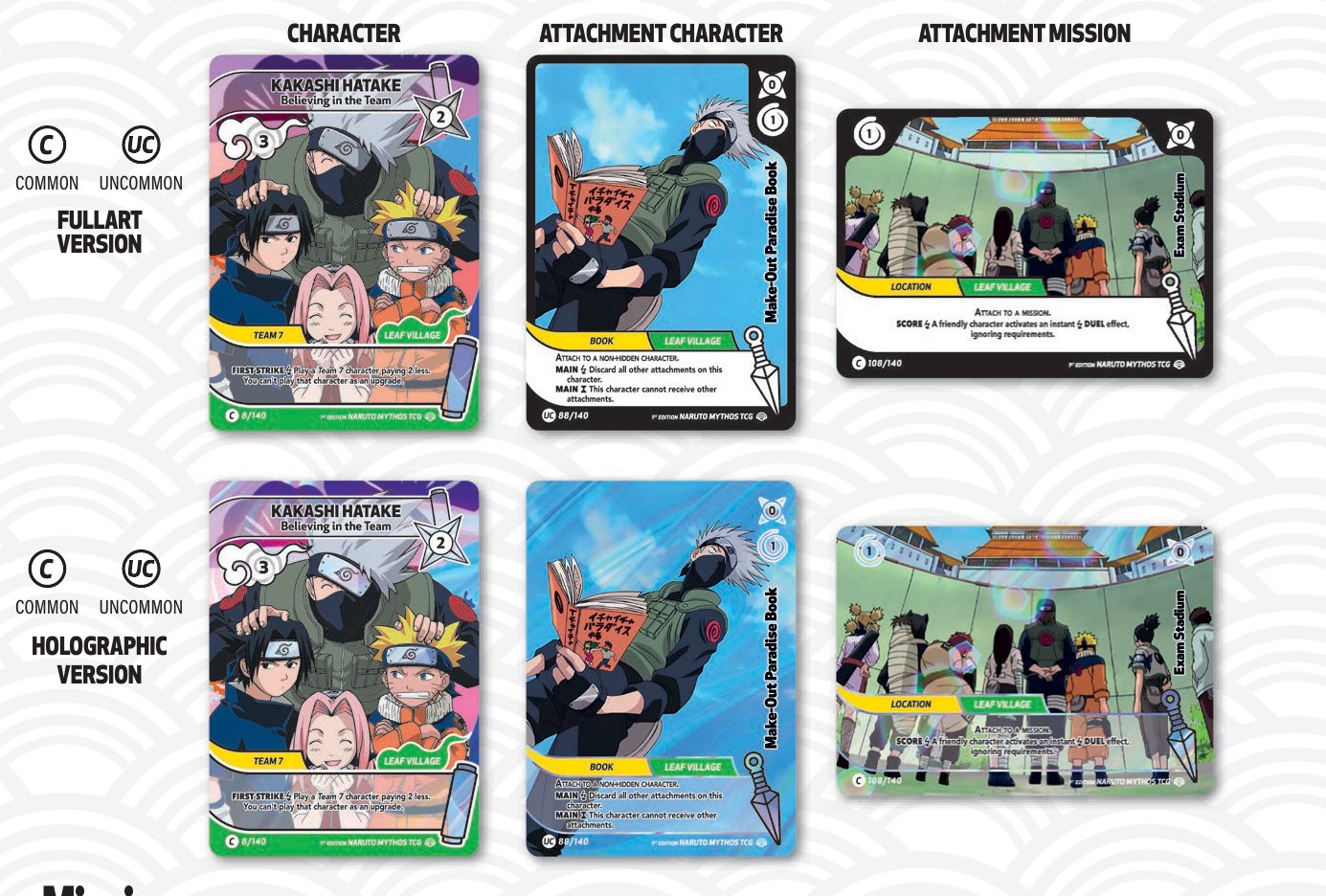 Shinobi Shiren's versions by card type, from CICABOOM's collection guide.
The rarity ladder
From a booster's ordinary run upward:
- Common (C) and Uncommon (UC): the base of the set, printed in the versions described above.
- Rare (R): one per pack.
- Rare Art (RA): a full art take on a Rare, printed as its own card. It
shares the Rare's collector number with an
Asuffix after the fraction, written104/130 Ain the publisher's checklist. This catalogue lists it as a separate printing of the same number rather than using the suffix. - Secret: chase cards numbered past the set size, about 1 in 10 packs.
- Secret Variant: a distinct printing of a Secret's number, not a typo for it. In Konoha Shidō there are 4 Secret Variant cards at 75 numbered copies each, 300 copies in total.
- Legendary: the rarest booster pull, about 1 in 800 packs, each copy numbered out of 2000.
- Mythos: promo cards, distributed outside the ordinary booster run.
- Mission: objective cards numbered with an
MSSprefix instead of a plain number,MSS 01in set 1 andMSS01/140in set 2.
Set 2's four new rarities
Shinobi Shiren added four rarities that exist in no other game. The publisher describes them like this:
- Special: full art variants of selected Rare cards, with holographic brushstrokes, engraved detail, gold accents and textured inlays that give the card a raised, tactile finish.
- Chibi: selected characters redrawn in a playful SD style, with rainbow holographic foil, serigraphic texture and gold accents. Not found in booster packs: they top the boxes, and the rest come from official events.
- Shinobi: cards built on the most iconic duels of the Chūnin Exams, designed in pairs: place them side by side and the battle scene reassembles. Each carries artwork exclusive to this rarity, marked by the Crown icon.
- POP: the rarest addition to the set, with individually serialized copies printed on lenticular holographic stock that shifts as it moves, with a gold frame around the numbering.
The names are exactly Chibi, POP, Special and Shinobi. Some shops write "Chibi V" or "Special V", but the publisher's material has no V treatments at all, and this catalogue follows the publisher.
Editions: 1st and 2nd are not the same set
Konoha Shidō exists in a 1st and a 2nd edition, and they are not reprints of each other. The two editions have different Secret Variants and different Gold cards. If you collect chase cards, the edition matters as much as the number.
Promos and stamps
Mythos cards are promos distributed outside boosters. Separately, some cards
carry a stamp printed on the face, such as Weekly Tournaments or
Store Championship. A stamp is part of the printing: a stamped card is a
different collectible from its unstamped twin, and this catalogue lists it
separately.
Why numbers run past the set size
Konoha Shidō is written /130, but its numbers reach 148. Everything from
131 up is a chase or promo printing that was never part of the base run:
Secrets, Secret Variants, Legendaries and Mythos promos. A number bigger than
the set size is normal here, not an error.
What a booster contains
From the Konoha Shidō collection guide:
- 4 Commons, 3 Uncommons, 1 Rare, and 1 holographic card, which is either a Rare Art, a Common Holo or an Uncommon Holo.
- A Secret appears in roughly 1 in 10 packs.
- A Legendary appears in roughly 1 in 800 packs, numbered out of 2000.
The two artwork icons
The publisher marks special artwork with two icons:
- Rosette, unreleased artwork: art revealed for the first time in NARUTO Mythos TCG.
- Crown, exclusive artwork: original art created exclusively by Studio Pierrot, starting with Shinobi Shiren.
Sources
Everything on this page comes from the publisher, CICABOOM:
- Konoha Shidō collection guide, 1st edition (PDF)
- Konoha Shidō collection guide, 2nd edition (PDF)
- Shinobi Shiren collection guide (PDF)
- Rarity overview on the official site
Card images are excerpts from those collection guides and belong to CICABOOM S.r.l. NARUTO is a trademark of its respective owners; this page is a collector reference and is not affiliated with the publisher.