The same Magic card can sit in one set under four collector numbers, each with its own art or frame and its own price. What tells them apart is printed on the card: a number, a rarity letter or symbol colour, a set code, and a small mark that says whether the card is foil. This guide shows where each of those sits, how to read it, and what Card DB and Cardmarket call the result, so the card you list is the card you hold.
Where the card tells you what it is
Everything that identifies a printing is in the bottom left corner, under the text box. What is printed there depends on when the card was made.
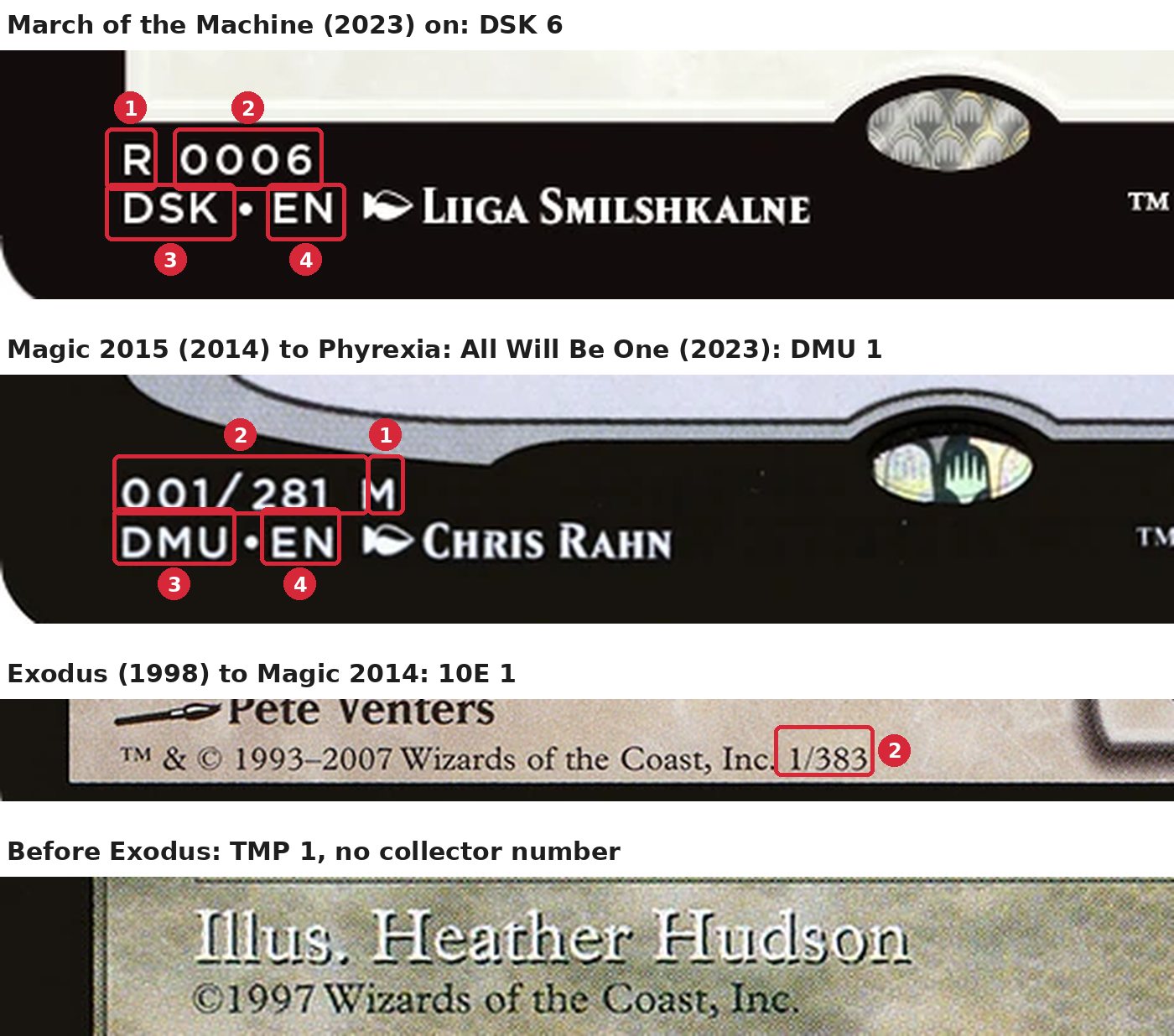 1 rarity letter, 2 collector number, 3 set code, 4 language. Crops of Card
DB card images: DSK 6, DMU 1, 10E 1, TMP 1.
- March of the Machine, 2023 on. Two lines: the rarity letter and a
four-digit number,
R 0006, then the set code and the language,DSK • EN. There is no set size. - Magic 2015 to Phyrexia: All Will Be One, 2014 to 2023. The number comes
first, over the set size, then the rarity letter:
001/281 M. The second line is the same,DMU • EN. A number above the set size, which is a special version, prints without the set size:400 R. - Exodus to Magic 2014, 1998 to 2013. No set code and no rarity letter.
The number and the set size sit at the end of the copyright line:
1/383. - Before Exodus. No collector number at all. The bottom of the card holds only the artist and the copyright.
On a card from 2014 on (not on retro-frame cards), the set code is printed: DSK is Duskmourn: House of
Horror, DMU is Dominaria United. Before that, the set is shown only by its
symbol on the right of the type line, and core sets before Sixth Edition have
no symbol at all. The quickest way to name an older set is
to search the card's name in Card DB and compare the symbol and the number.
Cards from before Exodus still have a number in Card DB, but it is not printed on the card, so you cannot read it off. Find those cards by name and set.
How Card DB writes the number
Card DB drops the leading zeros and never writes a set size: the card that
prints R 0006 and DSK • EN is DSK 6, and the card that prints
001/281 is DMU 1.
Rarity: the letter and the symbol colour
From 2014 on (not on retro-frame cards), the rarity is a letter in the collector line. On every card since Exodus, except some Special cards (see below), it is also the colour of the set symbol on the right of the type line.
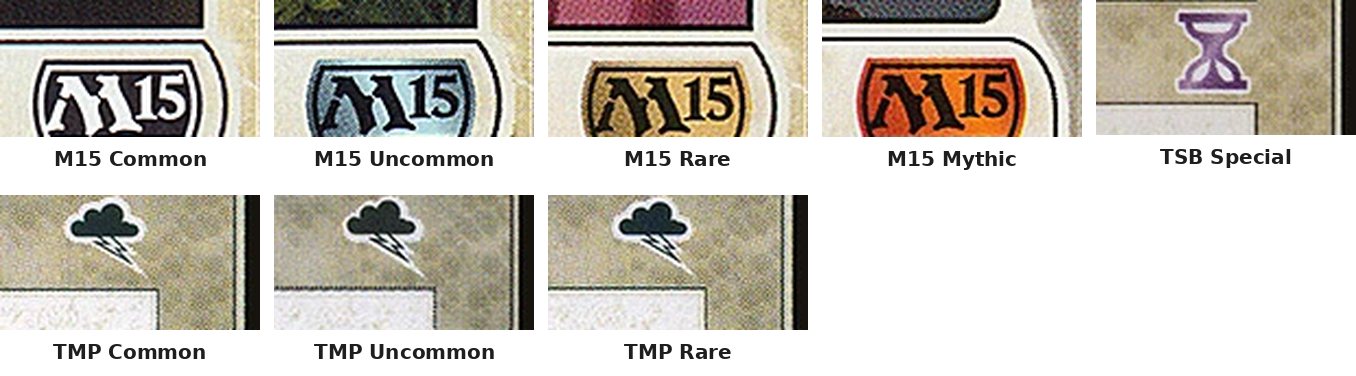 Crops of Card DB card images: M15 10, 2, 3 and 1; TSB 1; TMP 1, 2 and 6.
| Letter | Symbol colour | Card DB rarity |
|---|---|---|
C |
Black, or white | Common |
U |
Silver | Uncommon |
R |
Gold | Rare |
M |
Red-orange | Mythic |
L (basic land) |
Black, or white | Common |
S, or none |
Purple on the Time Spiral timeshifted cards, otherwise the normal colour | Special |
- Before Exodus (1998) every set symbol is black, whatever the rarity. The three Tempest symbols above are a Common, an Uncommon and a Rare. On those cards the symbol tells you the set, never the rarity.
- Mythic starts with Shards of Alara (2008). No earlier set in Card DB has a Mythic card.
- Basic lands print
L. Card DB files them as Common. - Special is not only Time Spiral. The Prismatic Piper prints
S(001/361 Sin Commander Legends) under a black and white symbol. - Rarity can change between printings of one card. Duskmourn's Enduring
Innocence prints
Rat number 6 andMat numbers 386 and 396. Read the letter on your card, not on the first printing you find.
One card, several collector numbers
In Magic, a card's special versions are not variants of one number. Each borderless, extended-art or showcase version has its own collector number, and Card DB lists every one of those numbers as its own card.
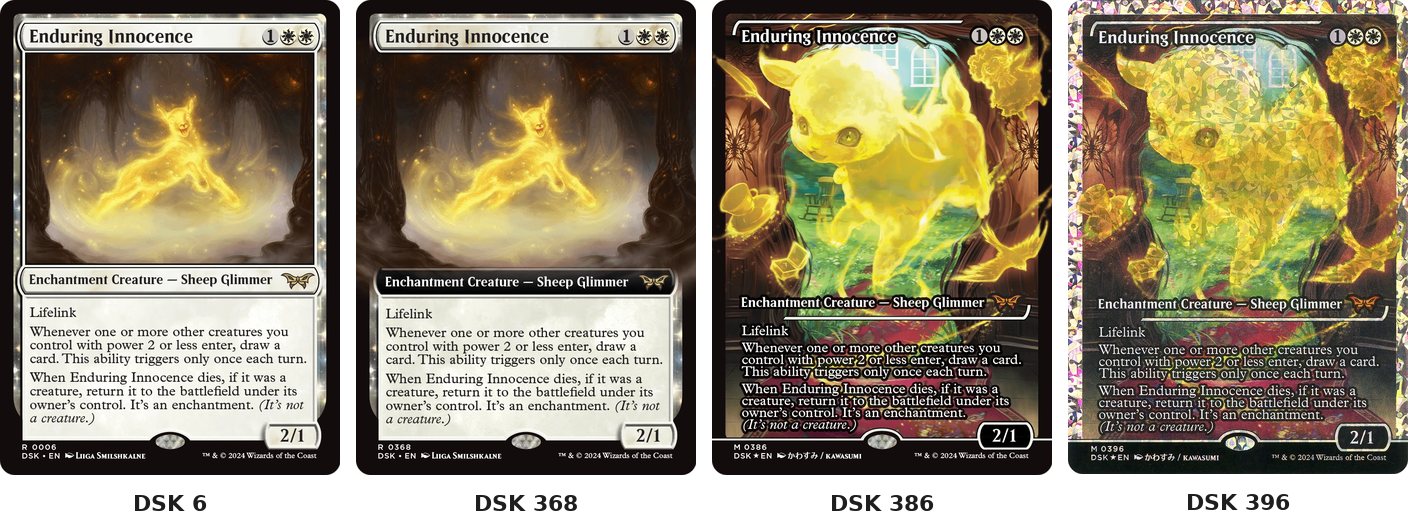 Enduring Innocence in Duskmourn: House of Horror. Card DB card images.
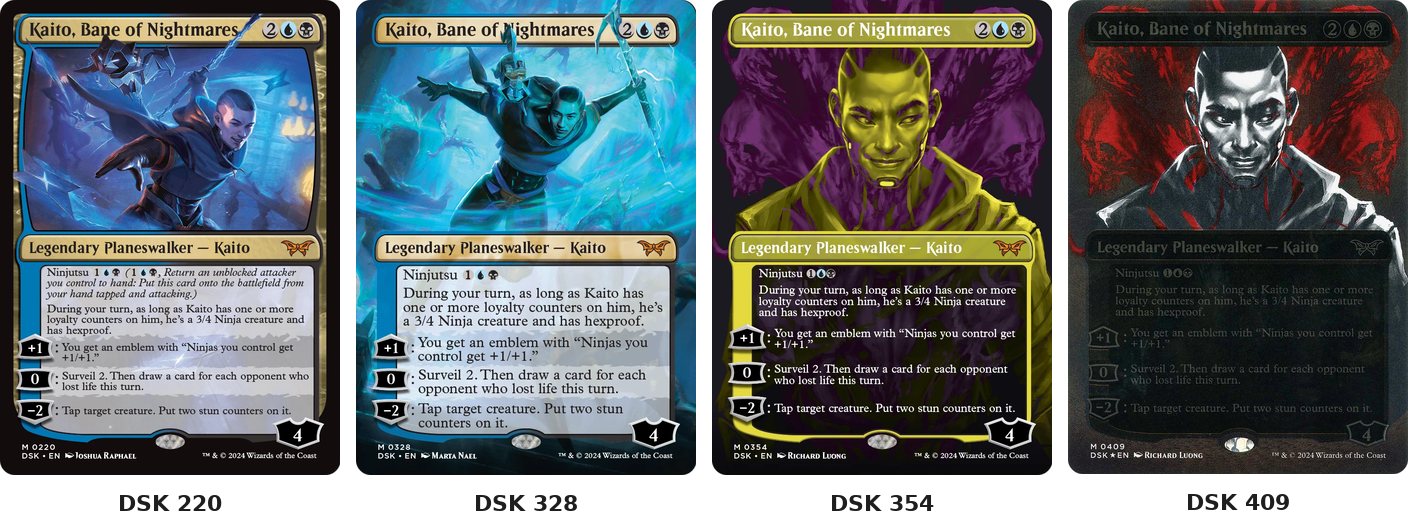 Kaito, Bane of Nightmares in the same set. Card DB card images.
| In Card DB | What it is |
|---|---|
DSK 6 Enduring Innocence |
The regular card |
DSK 368 Enduring Innocence |
Extended art: the art runs to both side edges |
DSK 386 Enduring Innocence |
Japan Showcase, art by a Japanese artist, foil |
DSK 396 Enduring Innocence |
Japan Showcase in fracture foil |
DSK 220 Kaito, Bane of Nightmares |
The regular card |
DSK 328 Kaito, Bane of Nightmares |
Borderless |
DSK 354 Kaito, Bane of Nightmares |
Borderless double exposure |
DSK 409 Kaito, Bane of Nightmares |
Double exposure in textured foil |
Wizards of the Coast's own guide to the set uses the same numbers, and says the Japan Showcase and textured foil cards come only from Collector Boosters.
In Duskmourn, each of the 99 cards that has more than one number has its lowest number in the main set, 1 to 286. The numbers above 286 are the special versions. Basic lands are the exception: each has two or three numbers inside 1 to 286. The number is the fastest way to tell which one you hold: the rarity letter and the name are often the same.
Letters and marks after the number
Some numbers in Card DB carry more than digits:
| In Card DB | What it is | Printed on the card? |
|---|---|---|
LCI 410a, FIN 551a, ZEN 233a |
A letter for one of several arts at the same number | Yes, 0410a, 0551a, 233a/249 |
ALL 13a, ALL 13b |
Two arts of one card in a set from before Exodus | No, those sets print no number |
RVR 337z |
A serialized printing | No. The card prints 337 and a serial number on the art, XXX/500 |
A serialized card prints a collector number without the z, and a serial
number such as 123/500 on the art. In Murders at Karlov Manor the printed
number need not be the card's own: Aurelia, the Law Above at MKM 317z prints
M 0320. Find a serialized card by its name and pick the z row.
Foil or not: read the collector line
Most collector numbers come in both foil and non-foil, at different prices. A foil is listed on the same Card DB card as the non-foil of its number; on Cardmarket you tick Foil.
 Crops of Card DB card images: DSK 368 and DSK 386.
From Magic 2015 on, the mark between the set code and the language says
which you hold. The Comprehensive Rules: the two codes "are separated by a
bullet point. If a card is premium, these codes are instead separated by a
star." A foil card shows the star: so do the foil-only printings in this
guide, DSK 386, DSK 396 and DSK 409.
DSK • EN: a non-foil card.DSK ★ EN: a foil card.
Three things the line does not tell you:
- Cards from before 2014, and retro-frame cards in newer sets, have no such
line. A retro-frame card such as
RVR 337prints only its number after the copyright, the way old cards did. Tilt the card under a light. - The silver oval at the bottom centre is not a foil. Since Magic 2015 Rares and Mythics in the modern frame carry a small holofoil stamp, foil or not. Commons and Uncommons do not.
- Which kind of foil. The fracture foil
DSK 396and the textured foilDSK 409show the same star as any other foil. In Duskmourn each has its own number, so the number tells you.
Foil-etched
Foil-etched cards are less shiny than a regular foil, with a slightly matte, grainy finish on the foiled parts. In Card DB they appear in two ways:
- With their own number. Commander Legends' foil-etched cards have
numbers of their own, such as
CMR 530 Prossh, Skyraider of Kher. - Sharing a number. In Modern Horizons 2, a card such as
MH2 389
  Aeromoeba
exists non-foil, foil and foil-etched under one number. Card DB has one row for all three.
Cardmarket treats foil-etched cards differently from other foils: it lists them as a separate version, not as a box you tick.
How Card DB names a card
A card's full name in Card DB is:
SET NUMBER Name
DSK 6 Enduring Innocence: the regular card.DSK 386 Enduring Innocence: a special version, by its own number.RVR 337z Legion Warboss: a serialized printing.DSK 287 Grand Entryway // Elegant Rotunda: a double-faced card keeps both names, joined by//.
There is no variant word at the end. Every Magic printing that Card DB lists is told apart by its number, so the number is what you must get right. Rarity, foil and the booster a card came from are never part of the name.
How Cardmarket handles it
- Each collector number is its own product.
DSK 6andDSK 368are two products with two prices. List a borderless or showcase card on its own product, not on the regular card's. - Cardmarket's product name is the card name only. It shows no collector number, so one expansion can have several products called Enduring Innocence. Cardmarket labels same-name products V.1, V.2 and so on, and says those version numbers do not follow one scheme across sets. Compare the picture with your card.
- Foil is a box you tick, on the same product. A foil
DSK 6is listed on theDSK 6product with Foil ticked, and sells at that product's foil price. - Foil-etched is the exception. Cardmarket lists foil-etched cards as their own version. For Kaldheim and Commander Legends it puts them in a separate "Extras" expansion.
- The price Card DB shows for a Magic card is the non-foil price. For a foil, use the product's foil price on Cardmarket.
- Prerelease and promo-pack cards are their own products. The foil
prerelease card with a year stamp and the stamped promo-pack card of
Enduring Innocence are two more Cardmarket products, apart from
DSK 6.
Language
- On the card: from Magic 2015 on, the code after the set code is the
card's language:
ENon English cards. Before that, read the card text. - Japan Showcase cards come in English or Japanese. The art and the
artist's name look Japanese either way. Wizards says that outside Japanese
Collector Boosters they are English two thirds of the time. The language
code tells you:
DSK ★ ENonDSK 386is an English card. - On Cardmarket: you pick the card's language when you list it.
Mistakes that cost money
- A foil listed as non-foil, or the other way round. On cards from 2014 on (not on retro-frame cards), check for the star.
- An extended-art, borderless or showcase card listed on the regular card's product. Check the collector number.
- A serialized card listed as the regular printing. Look for the serial number on the art.
- A Japan Showcase card listed in the wrong language. Read the code, not the art.
- A prerelease or promo-pack card, with a stamp on it, listed as the regular card. Cardmarket lists each as its own product.
- A foil-etched card listed as a regular foil.
- The holofoil stamp on a Rare read as a sign of a foil card.
- An old card with a black set symbol listed as a common because of the colour. Before Exodus, the colour says nothing about rarity.
Sources
- Card images: Card DB. The collector lines, set symbols and both Duskmourn rows are Card DB card images, cropped.
- Card names, numbers and rarities: the Card DB catalogue.
- Magic: The Gathering Comprehensive Rules, Wizards of the Coast: rule 206.2 (symbol colours, all black before Exodus) and rule 213 (collector number, rarity letter, the bullet and the star).
- Collecting Duskmourn, Wizards of the Coast: the numbers of each special version, which boosters carry them, the language of Japan Showcase cards, and the year-stamped prerelease card.
- New Card Frame for Magic 2015, StarCityGames, quoting Aaron Forsythe of Wizards R&D: the collector line, the star on premium cards, the holofoil stamp on rares and mythics.
- Differentiating Foils and the Seller Guide, Cardmarket's help centre: foil-etched versions and "Extras", V.1 and V.2 versions, the Foil and language attributes of a listing.
- Cardmarket's public product list: the separate products for the regular, special, prerelease and promo-pack Enduring Innocence.
Magic: The Gathering card images and names belong to Wizards of the Coast. This page is a collector reference and is not affiliated with Wizards of the Coast.